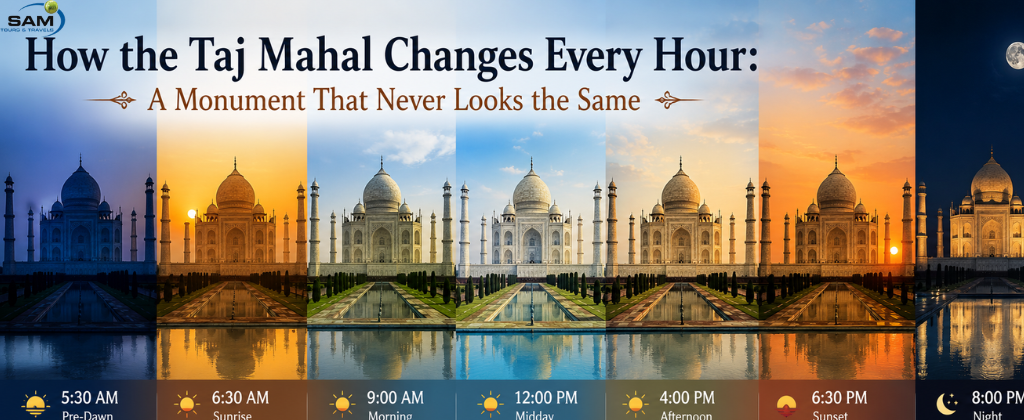
The Taj Mahal is often described as the most beautiful building in the world. However, what many visitors don’t realize is that the monument never looks exactly the same twice. Unlike ordinary buildings, the Taj Mahal changes its appearance every hour as sunlight, weather, seasons, and the famous Makrana marble interact throughout the day. From the soft pink glow of sunrise to the brilliant white of midday and the golden hues of sunset, every moment offers a different perspective of this architectural masterpiece.
Architects, photographers, historians, and travelers all agree that the Taj Mahal is a living monument. Although its structure remains unchanged, its colors, reflections, shadows, and atmosphere transform continuously. As a result, many people visit the Taj Mahal more than once simply to experience these changing moods.
If you want to understand why the Taj Mahal remains one of the world’s greatest wonders, take a journey through every hour of the day and discover how this magnificent monument constantly reinvents itself.
Why Does the Taj Mahal Change Every Hour?
The secret lies in its construction material. The Taj Mahal is built primarily from Makrana marble, a premium white marble from Rajasthan known for its exceptional purity and reflective qualities.
Unlike ordinary stone, Makrana marble absorbs and reflects sunlight differently depending on the angle of the sun, cloud cover, humidity, and surrounding environment. Consequently, the monument appears to change color even though the marble itself remains the same.
Furthermore, the Yamuna River, surrounding gardens, blue sky, seasonal weather, and air quality all influence how visitors perceive the monument at different times of the day.
Before Sunrise: A Silent Marble Shadow
Before the first rays of sunlight reach Agra, the Taj Mahal appears mysterious and peaceful. The white marble reflects very little light, creating soft grey and bluish tones.
At this hour, photographers appreciate the calm atmosphere because the monument stands almost silently against the gradually brightening sky.
Birdsong replaces daytime crowds, while cool morning air makes the experience especially memorable.
Although few people witness this moment, architects often consider it one of the most elegant views of the monument.
Sunrise (6:00–7:00 AM): The Famous Pink Glow
Sunrise is widely considered the best time to visit the Taj Mahal.
As the first sunlight touches the marble, the monument slowly transforms from pale grey into delicate shades of pink, peach, and soft gold.
This magical transition lasts only a short time. Therefore, photographers often arrive before sunrise to capture the complete transformation.
Moreover, the lower temperatures and smaller crowds allow visitors to enjoy peaceful views while taking beautiful photographs without large groups in the background.
Many local guides recommend sunrise because this is when the Taj Mahal looks most romantic.
Early Morning (7:00–9:00 AM): Bright and Fresh
As the sun rises higher, the pink tones gradually disappear.
Instead, the marble becomes bright white while still reflecting gentle golden highlights. During these hours, the gardens also appear particularly vibrant because morning sunlight enhances the green lawns and flowering plants.
In addition, the famous reflecting pool produces almost perfect mirror images of the monument when the water remains calm.
Consequently, this period attracts photographers, travel bloggers, and architecture enthusiasts from around the world.
Mid-Morning (9:00–11:00 AM): Every Detail Comes Alive
By mid-morning, sunlight illuminates nearly every corner of the Taj Mahal.
At this stage, visitors can clearly observe intricate marble carvings, delicate floral inlay work, Quranic calligraphy, and geometric patterns that often remain hidden during lower light.
Architects especially enjoy this time because structural details become easier to study.
Furthermore, shadows become shorter, revealing the perfect symmetry that makes the monument famous worldwide.
Noon (11:00 AM–1:00 PM): Brilliant White Marble
During midday, the Taj Mahal reaches its brightest appearance.
Direct sunlight reflects strongly from the Makrana marble, making the monument appear almost pure white.
Although photographers sometimes avoid this period because of harsh lighting, architects appreciate it for another reason. Every proportion, alignment, and decorative element becomes clearly visible without dramatic shadows.
However, temperatures also rise quickly, especially during summer. Therefore, visitors should carry water, wear comfortable clothing, and use sunscreen if visiting at noon.
Afternoon (1:00–4:00 PM): Soft Shadows Return
As the afternoon progresses, sunlight begins striking the monument from a different angle.
Consequently, gentle shadows reappear across arches, domes, and marble carvings.
These shadows create additional depth, making decorative details appear more three-dimensional than during midday.
Meanwhile, photographers begin preparing for the evening because the changing light creates increasingly dramatic compositions.
Golden Hour (4:00–6:00 PM): Warm Colors Everywhere
Many professional photographers consider the golden hour one of the best times to photograph the Taj Mahal.
During this period, sunlight becomes softer and warmer.
Instead of appearing bright white, the marble develops subtle golden, cream, and honey-colored tones.
The long shadows stretching across the Charbagh gardens add visual depth, while reflections in the water channels become even more attractive.
As a result, the monument appears warmer and more inviting than at any other time during the day.
Sunset: A Dramatic Transformation
Sunset offers one of the most spectacular views of the Taj Mahal.
As the sun approaches the horizon, the marble absorbs warm orange, amber, and golden light.
Gradually, the monument changes from brilliant white into glowing shades of cream and light orange before fading into cooler evening colors.
Although crowds increase during sunset, the breathtaking scenery makes the visit worthwhile.
Moreover, the sky often displays beautiful shades of pink, purple, and orange, creating unforgettable photographs.
Twilight: Peace Returns
Shortly after sunset, daylight begins to disappear.
The Taj Mahal slowly changes from warm golden colors into cool blue-grey tones.
During this brief period, artificial lighting remains minimal, allowing visitors to experience the monument in a peaceful atmosphere.
Architects often describe twilight as the moment when the building appears most balanced because strong sunlight no longer dominates its appearance.
Moonlight: The Silver Taj Mahal
Few visitors have the opportunity to witness the Taj Mahal under a full moon.
During approved night-viewing sessions, moonlight transforms the white marble into glowing silver.
Instead of reflecting bright colors, the monument appears calm, mysterious, and almost dreamlike.
The surrounding gardens become quiet, while shadows create dramatic contrasts around the domes and minarets.
Because night viewing is limited to selected dates each month, many travelers consider it one of the most exclusive experiences in India.
Weather Creates New Personalities
Sunlight isn’t the only factor influencing the Taj Mahal’s appearance.
Different weather conditions produce completely different moods.
For example, after rain, the marble often looks cleaner and brighter because dust has been washed away.
Meanwhile, cloudy skies soften the light, creating gentle grey tones that photographers often love.
During winter mornings, light fog surrounds the monument, making it appear as though it is floating above the gardens.
In contrast, clear summer skies produce the brightest white marble of the entire year.
Therefore, no two visits ever feel exactly the same.
Every Season Brings a New Look
The Taj Mahal changes not only every hour but also every season.
During winter, mist creates soft, dreamy photographs.
Spring fills the gardens with colorful flowers.
Summer produces brilliant white reflections under intense sunlight.
Monsoon rains make the surrounding greenery appear richer and more vibrant.
Finally, autumn offers clear blue skies and comfortable temperatures, making it one of the most popular seasons for photography.
Consequently, experienced travelers often return in different seasons to experience these changing landscapes.
Why Photographers Visit Again and Again
Professional photographers rarely visit the Taj Mahal only once.
Instead, they return repeatedly because every hour provides different lighting conditions.
Some prefer sunrise for delicate pink tones.
Others choose midday for architectural details.
Many wait until sunset for warm golden light, while a lucky few capture the monument beneath the full moon.
Because lighting changes constantly, photographers believe the Taj Mahal offers endless creative possibilities.
Tips for Seeing Every Version of the Taj Mahal
If you want to experience the monument’s changing beauty, plan your visit carefully.
Arrive before sunrise to witness the first rays of light.
Spend several hours exploring the gardens as the colors gradually change.
Visit Mehtab Bagh in the evening for beautiful views across the Yamuna River.
If possible, book a full-moon night viewing to experience the silver glow that few visitors ever see.
Finally, consider visiting during different seasons because each one reveals another side of this remarkable monument.
Final Thoughts
The Taj Mahal is far more than a magnificent marble building. It is a living work of art that transforms every hour through the changing effects of sunlight, weather, seasons, and atmosphere. From the soft pink hues of sunrise to the brilliant white of midday, the warm golden glow of sunset, and the enchanting silver shine beneath the moon, every moment reveals a different personality.
This constant transformation explains why the Taj Mahal continues to inspire architects, photographers, artists, and travelers from around the world. No matter how many times you visit, you will always discover something new. Rather than simply seeing a monument, you witness an ever-changing masterpiece where nature and architecture work together in perfect harmony.