The Taj Mahal is one of the world’s most recognizable landmarks, yet most visitors experience only a fraction of what it has to offer. Every year, millions of people walk through its grand entrance, admire the white marble, capture a few photographs, and leave believing they have seen everything. In reality, the monument is filled with fascinating details that often go unnoticed.
Built by Mughal Emperor Shah Jahan in memory of his beloved wife Mumtaz Mahal, the Taj Mahal is much more than a symbol of love. It is a masterpiece of architecture, engineering, mathematics, art, and symbolism. Every carving, arch, pathway, and garden was designed with extraordinary care. The closer you look, the more secrets you discover.
This guide uncovers many of the hidden details that make the Taj Mahal one of the greatest architectural achievements ever created.
Your Journey Begins Before You Enter
The experience starts long before you reach the white marble mausoleum. The massive red sandstone entrance gate is not merely an entrance. Instead, it prepares visitors for a dramatic first glimpse of the monument.
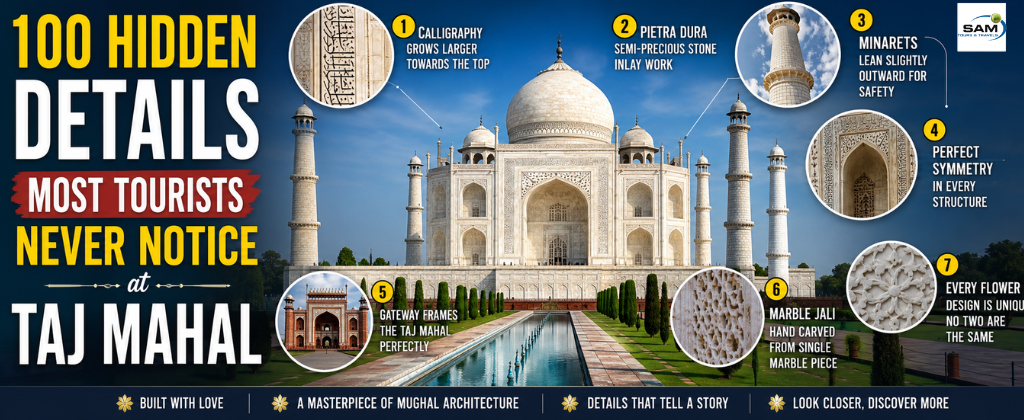
Stand beneath the central arch and notice how perfectly it frames the Taj Mahal. The architects intentionally created this viewpoint to build excitement before visitors entered the gardens.
Another fascinating detail is the optical illusion created by the gateway. As you walk forward, the Taj Mahal appears to change in size. This clever design makes the monument feel even more majestic.
The Gardens Tell a Story
Many visitors walk quickly through the gardens to reach the main building. However, these gardens are an important part of the monument.
The famous Charbagh layout divides the landscape into four equal sections. Flowing water channels represent the rivers of Paradise described in Islamic tradition. Meanwhile, the trees, fountains, and pathways symbolize harmony, peace, and eternal life.
Every path leads your eyes naturally toward the mausoleum. As a result, the gardens become part of the overall architectural experience rather than simple decoration.
The Marble Is Full of Surprises
At first glance, the Taj Mahal appears to be made from plain white marble. Look closer, and you’ll notice natural veins running through every slab. No two pieces are exactly alike.
The marble came from Makrana in Rajasthan and remains famous for its exceptional quality. It reflects sunlight beautifully, which explains why the monument changes colour throughout the day.
During sunrise, it often appears soft pink. By afternoon, it becomes brilliant white. At sunset, warm golden shades spread across the walls before turning silver beneath the moonlight.
This natural transformation continues to amaze photographers and travellers alike.
Hidden Art in Every Wall
The colourful flowers decorating the walls are not painted. Instead, skilled craftsmen used the ancient Pietra Dura technique to create them.
Tiny pieces of jasper, jade, lapis lazuli, turquoise, agate, and carnelian were carefully cut and fitted into carved marble. Every stone was polished until the surface became perfectly smooth.
Interestingly, no two floral designs are completely identical. Although they appear symmetrical, each flower includes small differences that give the artwork a natural appearance.
The Calligraphy Is Smarter Than You Think
One of the monument’s greatest artistic achievements surrounds the entrance to the mausoleum.
The Quranic inscriptions appear uniform from the ground. However, the letters become larger as they move upward. This adjustment creates a visual illusion that makes every line appear the same size.
Even more impressive, the inscriptions are not painted. Black marble was carefully inlaid into the white stone, ensuring that the artwork would last for centuries.
Engineering Ahead of Its Time
The Taj Mahal continues to impress engineers because of its remarkable construction techniques.
For example, each of the four minarets leans slightly outward. Although the angle is almost impossible to notice, it serves an important purpose. If an earthquake were ever to occur, the towers would fall away from the central mausoleum instead of onto it.
The builders also constructed a strong foundation using deep wells filled with stone and timber. This innovative solution helped support the enormous weight of the monument near the Yamuna River.
A Masterpiece of Symmetry
Symmetry defines the Taj Mahal.
Stand along the central pathway and notice how almost everything has a matching counterpart. The mosque balances the Jawab building. The gardens mirror one another. Even the fountains align perfectly with the central axis.
This balance creates a peaceful atmosphere that visitors often feel without realizing why.
However, there is one famous exception.
Inside the mausoleum, Shah Jahan’s cenotaph sits slightly beside Mumtaz Mahal’s. It is the only major element that breaks the monument’s perfect symmetry because the emperor was buried there years after the original design was completed.
Details Hidden Inside
The interior of the Taj Mahal rewards careful observation.
Delicate marble lattice screens surround the cenotaphs. Many were carved from single blocks of marble with astonishing precision.
Look down at the floor, and you’ll discover geometric patterns created from different colours of stone. These designs have survived millions of footsteps while maintaining their beauty.
Above, the magnificent dome creates gentle echoes that demonstrate the builders’ remarkable understanding of acoustics.
The River Was Part of the Design
Today, many visitors spend little time near the rear terrace overlooking the Yamuna River. Nevertheless, the river formed an important part of the original design.
Construction materials arrived by boat. The flowing water cooled the surrounding environment. Furthermore, the river reflected the monument, adding another layer of beauty to the landscape.
Many historians believe the riverside setting was carefully chosen for both practical and symbolic reasons.
Small Details Most Visitors Miss
Some of the monument’s most fascinating features are surprisingly easy to overlook.
Notice how the marble remains cool even on warm days.
Observe the tiny joints between inlaid stones that remain almost invisible.
Study the carved flowers closely and compare one design with another.
Watch how changing sunlight creates new shadows across the carvings every hour.
Look at the decorative borders around arches and windows, where every pattern reflects exceptional craftsmanship.
Finally, pause beside the reflecting pool. The reflection changes constantly as the light and breeze shift, creating a different view every few minutes.
Why Every Visit Feels Different
Many travellers return to the Taj Mahal several times. Each visit reveals something new.
Perhaps it’s a flower hidden within the marble.
Maybe it’s the changing colours of the dome.
Sometimes it’s the perfect symmetry of the gardens or the quiet beauty of the Yamuna River behind the monument.
These discoveries remind visitors that the Taj Mahal is not simply a famous landmark. It is a living work of art that continues to reward curiosity.
Final Thoughts
The Taj Mahal has earned its reputation as one of the Seven Wonders of the World for good reason. Its beauty extends far beyond its famous white dome. Every pathway, carving, inscription, and architectural feature contributes to a larger story of creativity, devotion, and extraordinary craftsmanship.
Instead of rushing through the complex on your next visit, slow down. Look beyond the obvious. Notice the marble beneath your hands, the symmetry around you, the reflections in the water, and the stories hidden within the stone.
The greatest beauty of the Taj Mahal is not found in a single photograph. It is discovered through the countless details that most tourists never notice.
Whether you are visiting for the first time or returning to admire it again, take a closer look. You may leave with a completely new appreciation for one of the world’s greatest masterpieces—and perhaps discover a hidden detail that becomes your favourite memory of the Taj Mahal.