
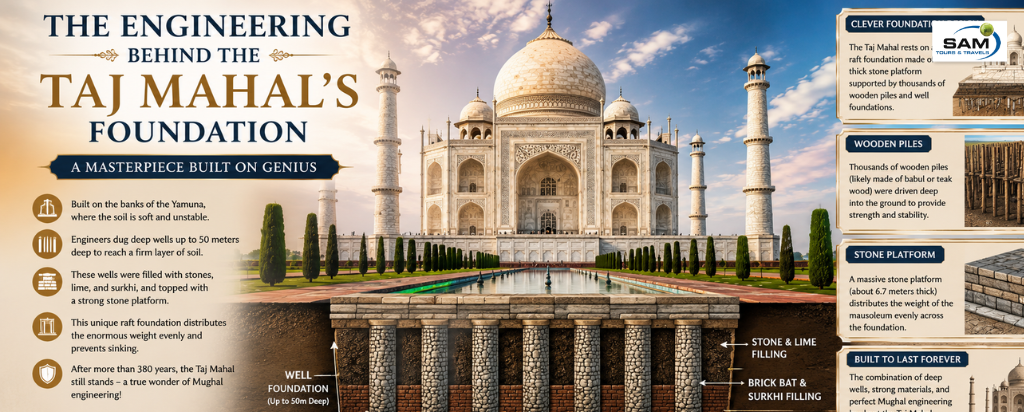
The Taj Mahal is celebrated around the world for its breathtaking beauty, perfect symmetry, and timeless story of love. Yet beneath its gleaming white marble lies an engineering achievement that receives far less attention. While millions admire its elegant dome and intricate carvings, few realize that the monument’s greatest strength is hidden underground. The Taj Mahal’s foundation is one of the most remarkable examples of Mughal engineering, enabling the structure to remain stable for more than 370 years despite its immense weight and location beside the Yamuna River.
Constructed between 1632 and 1653 under the patronage of Emperor Shah Jahan, the Taj Mahal presented engineers with a significant challenge. The chosen site featured soft alluvial soil deposited by the Yamuna River over centuries. Such soil is generally unsuitable for supporting a massive marble mausoleum. Instead of relocating the project, Mughal engineers developed an innovative foundation system that was far ahead of its time.
Why Building Near the Yamuna River Was Challenging
The Taj Mahal stands on the southern bank of the Yamuna River. Riverbank soil is naturally loose and contains layers of sand, silt, and clay. Heavy buildings constructed directly on this type of ground are vulnerable to settlement, tilting, or structural damage.
For the Mughal builders, selecting this location was intentional. The river enhanced the monument’s beauty, provided a cooling environment, and formed part of the imperial riverfront garden tradition. However, it also required extraordinary engineering solutions to ensure long-term stability.
The Ingenious Well Foundation System
Rather than relying on a single continuous concrete base as used in modern construction, Mughal engineers created a network of deep masonry wells beneath the monument.
Hundreds of cylindrical wells were excavated into the ground until they reached stable soil layers. These wells were then filled with carefully arranged stone, brick, lime mortar, and rubble to create strong vertical supports.
Each well functioned like an individual foundation column. Together, they distributed the enormous weight of the Taj Mahal evenly across the ground, reducing the risk of uneven settlement.
This well-foundation technique was widely used in Mughal engineering but reached its highest level of sophistication at the Taj Mahal.
Timber: An Unexpected Structural Material
One fascinating aspect of the Taj Mahal’s foundation is the reported use of timber beams within parts of the substructure. Wood might seem like an unusual choice for such a monumental building, but submerged timber can remain remarkably durable when kept continuously wet.
The proximity of the Yamuna River historically helped maintain groundwater levels around the foundation, creating conditions that protected the timber from decay.
This demonstrates the Mughal engineers’ practical understanding of local environmental conditions and available materials.
A Massive Stone Platform
Above the well foundations, engineers constructed a huge platform made of stone and brick masonry. This platform acts as an intermediary layer between the ground and the marble mausoleum.
The elevated platform serves several important purposes:
- Distributes structural loads evenly.
- Protects the monument from seasonal flooding.
- Creates a stable working surface.
- Enhances the monument’s visual prominence.
Even today, the platform contributes significantly to the stability of the structure.
Lime Mortar: The Mughal Equivalent of Modern Cement
The Taj Mahal predates modern Portland cement by nearly two centuries. Instead, builders relied on an advanced form of lime mortar.
Historical records suggest that this mortar included ingredients such as:
- Lime
- Sand
- Crushed brick (surkhi)
- Natural binding materials
- Organic additives like jaggery, plant extracts, and pulses in some traditional Mughal mixtures
These ingredients produced a durable, flexible material capable of withstanding minor movements without cracking excessively.
Weight Distribution Through Perfect Symmetry
Engineering and architecture worked together throughout the project.
The Taj Mahal’s symmetrical design is not only aesthetically pleasing but also structurally efficient.
The central dome, four minarets, side buildings, and marble platform all help balance loads across the foundation.
This balanced arrangement minimizes stress concentrations and contributes to the monument’s long-term stability.
Why the Minarets Lean Slightly Outward
A famous engineering feature of the Taj Mahal is its four minarets.
Although they appear perfectly vertical, each minaret was intentionally designed with a slight outward inclination.
This means that if an earthquake were ever to cause a collapse, the minarets would be more likely to fall away from the central mausoleum rather than onto it.
This reflects the builders’ awareness of structural safety as well as aesthetics.
The Role of the Yamuna River
The Yamuna River has always played a significant role in the monument’s engineering.
Historically, the river helped maintain groundwater conditions around the foundation. Some researchers believe these conditions benefited the submerged wooden components of the foundation system.
Modern environmental changes, including fluctuations in groundwater levels, have prompted ongoing monitoring and conservation efforts to ensure the monument’s long-term stability.
Modern Studies of the Foundation
Engineers and conservation experts continue to study the Taj Mahal using modern technologies such as:
- Ground-penetrating surveys
- Structural monitoring
- Laser scanning
- Digital modeling
- Geological investigations
These studies generally confirm the remarkable effectiveness of the original Mughal engineering while helping guide preservation work.
Common Myths About the Foundation
Several popular stories circulate about the Taj Mahal’s foundation, but not all are supported by historical evidence.
Myth: The Taj Mahal floats on water.
Reality: The monument does not float. It is supported by a sophisticated system of masonry well foundations beneath an elevated platform.
Myth: The foundation is made entirely of wood.
Reality: The primary foundation consists of masonry wells and stone construction. Timber may have been used in parts of the substructure, but it is not the sole structural support.
Myth: The monument is sinking rapidly.
Reality: While conservation challenges exist, the Taj Mahal remains structurally stable and is continuously monitored by experts.
Lessons Modern Engineers Can Learn
The Taj Mahal demonstrates several timeless engineering principles:
- Build according to local ground conditions.
- Distribute loads efficiently.
- Combine beauty with structural function.
- Use durable local materials.
- Design for long-term environmental conditions.
- Plan for resilience and maintenance.
These principles remain relevant in civil engineering today.
Frequently Asked Questions
What supports the Taj Mahal?
The Taj Mahal is supported by a network of deep masonry well foundations, an elevated stone platform, and carefully engineered load distribution.
Why was the Taj Mahal built near the Yamuna River?
The river enhanced the monument’s beauty, reflected Mughal riverfront garden traditions, and influenced the engineering of its foundation.
Is the Taj Mahal’s foundation made of wood?
Historical evidence suggests that timber was used in parts of the foundation system, but the primary structural support comes from masonry wells filled with stone, brick, and lime mortar.
How has the Taj Mahal survived for centuries?
Its innovative foundation, symmetrical design, durable materials, and continuous conservation have helped it remain stable for more than 370 years.
Is the foundation still being studied?
Yes. Conservation experts regularly use modern engineering techniques to monitor the monument’s condition and guide preservation efforts.
Final Thoughts
The Taj Mahal’s hidden foundation is as extraordinary as its world-famous marble exterior. Beneath the elegant domes, graceful arches, and intricate carvings lies a masterpiece of Mughal engineering that solved the complex challenge of building on soft riverbank soil. Through deep masonry wells, an elevated platform, advanced lime mortar, balanced structural design, and a thoughtful understanding of the local environment, the builders created a monument capable of enduring for centuries. Appreciating the engineering behind the Taj Mahal’s foundation reveals that its greatness is not only visible above ground but also firmly rooted beneath it, where innovation and craftsmanship continue to support one of the world’s most iconic landmarks.